Luigi Mangione: The New Abstract Painter
This is a selection from Caleb Maupin’s book The Danger of an American Years of Lead. The entire book is available for purchase here, and as a full audiobook here.
There is an odd parallel between what is written about effective counter-insurgency and what was discovered about the individual human mind. During the same period, the Cold War, the very same intelligence agencies in the United States and Britain that were overseeing counter-insurgency operations were also trying to discover the secrets of mind control.
The term “brainwashing” was coined by Edward Hunter, writing for the Miami News in 1950. John D. Marks' groundbreaking book The Search for the Manchurian Candidate describes the origins of the term that developed into a U.S. and British intelligence obsession: “He [Edward Hunter] made up his coined word from the Chinese hsi-nao, ‘to cleanse the mind’ — which had no political meaning in Chinese.”
Award-winning journalist Stephen Kinzer’s book The Poisoner in Chief: Sidney Gottlieb and the CIA Search for Mind Control describes the historical context: “Americans should have been able to celebrate the release of 7,200 soldiers from Communist prisons after an armistice ended the fighting in Korea in July of 1953. Instead, they recoiled in shock. Many prisoners, it turned out, had written statements opposing the United States or praising Communism. Some had confessed to committing crimes. Twenty-one chose to stay behind in North Korea or China. The Pentagon announced they would be considered deserters and executed if found.”

With Project MKULTRA, the CIA sought to develop methods of mind control.
British and American Mind Control Research
As Marks notes in his book: “By the end of the Korean War, 70 percent of the 7,190 U.S. prisoners held in China had either made confessions or signed petitions calling for an end to the American war in Asia. Fifteen percent had collaborated fully with the Chinese, and only five percent had steadfastly resisted… Worse, an alarming number of the prisoners stuck by their confessions after returning to the United States. They did not, as was accepted, recant when they stepped on U.S. soil. Puzzled and dismayed by the wholesale collapse of morale among POWs, American opinion leaders settled on Edward’s explanation: The Chinese had somehow brainwashed our boys.”
The arrogance with which American media observed the POW scandal can’t be overlooked. The reality is that the United States did indeed commit massive war crimes against the Korean people. The work of Bruce Cummings and other Korea scholars very well confirms that. The notion that the Korean people did not have the right to have a unified government in which the Korean Workers' Party participated alongside other parties hardly seems to morally justify the millions of deaths on the peninsula. The United States famously threatened to drop atomic bombs on China at one point during the war, and every building above one story tall in the northern half of Korea was destroyed. The idea that captured soldiers, seeing this from another angle, might, after being taken prisoner, apologize and denounce the war they had been sent to fight, isn’t hard to imagine without a huge dose of anti-communist assumptions. However, in the atmosphere of McCarthyism, the notion that some of the GIs may have been horrified by what they were ordered to do could not be entertained. Neither could the notion that any of the arguments of the Chinese or Korean captors were logically convincing.
Kinzer noted the media response and the atmosphere that led to decades of CIA research: “Newsweek described them [the American POWs] as ‘shifty-eyed and groveling’ and said they had betrayed their country in exchange for better treatment, because they had fallen in love with Asian women, or because of the appeal of ‘homosexualism.’ Several commentators warned they represented the weakening of American masculinity and the replacement by a generation of ‘pampered kids’ and ‘mama’s boys.’ Beyond the nation’s spiritual decline and the feminization of its men, another theory emerged: brainwashing.”
Regardless, the result was CIA project BLUEBIRD, which eventually became MKULTRA, which eventually became ARTICHOKE. All of it was the U.S. intelligence community trying to figure out how the Chinese and Soviet Communists were able to “brainwash” people, and then to develop their own methods for doing it.
Stephen Kinzer describes the project as a kind of tragic comedy, in which attempts to recreate what had been seen in horror movies and TV programs resulted in the CIA harming a lot of innocent people. Kinzer writes: “Two traumatic historical episodes — the testimony of Cardinal Mindszenty during his 1949 trial in Hungary and the behavior of American prisoners in Korea several years later — convinced senior CIA officers that Communists had discovered the key to mind control… The stories they imbibed as children and adults made those fears seem real. Lost in the blurry borderland between the fantasy and truth of mind control, they could not bring themselves to recognize the fantasy as the product of creative imagination. What the imagination could conceive, they believed the clandestine world could make real. MKULTRA was an attempt to invent a new reality.”
As John D. Marks described the program: “…the CIA built up its own elaborate brainwashing program, which, like the Chinese and Soviet versions, took its own special twist from our national character. It was a tiny replica of the Manhattan Project grounded in the conviction that the keys to brainwashing lay in technology.” The program involved a number of infamous episodes, such as Operation Midnight Climax, where the CIA set up a brothel and lured men with prostitutes to a location where they could be dosed with LSD and studied. The program also involved the agency studying the art of harassing individuals in order to induce a psychological breakdown. John D. Marks quotes one agency veteran describing how disgusted he was with the cruelty dished out to individuals in the hopes of learning how to manipulate their behavior: “That’s why I couldn’t even take reading the files after a while. I was sickened at seeing people take pleasure in other people's inadequacies. First of all, it was dumb. For all the money that went out, nothing ever came back… First, you’d check to see if you could destroy a man’s marriage. If you could, that would be enough to put a lot of stress on an individual, break him down. Then you might start a minor rumor campaign against him. Harass him constantly. Bump his car in traffic. A lot of it is ridiculous, but it may have a cumulative effect.”
Marks quotes agency insiders telling how they would capture a few teenage members of a street gang, spend some time attempting to “brainwash” them, and then send them to rejoin their comrades and weaken the group from within: “With gang warfare,” says an MKULTRA source, “you tried to get some defectors in place who would like to modify some of the group behavior and cool it. Now, getting a juvenile delinquent defector was motivationally not all that different from getting a Soviet one.”

Psychiatrist William Sargant’s ruthless “sleep room” experiments, coordinated with British Intelligence, resulted in multiple deaths.
At the same time that the U.S. CIA was engaged in its mind control research, MI6 was utilizing British psychiatrist William Sargant across the pond. His ruthless “sleep room” experiments were revealed decades later to have resulted in at least a few deaths, as he kept people asleep for months at a time, drugged as he tried to influence their minds in their sleep.
William Sargant published a book called The Mind Possessed in 1973 describing what much of his research had discovered about mind control, suggestibility, and its somewhat contradictory nature. Sargant wrote: “It is not the mentally ill but normal people who are the most susceptible to ‘brainwashing,’ ‘conversion,’ ‘possession,’ ‘the crisis,’ or whatever you wish to call it, and who in their hundreds of thousands or millions fall readily under the spell of the demagogue or revivalist, the witch-doctor, the pop group, the priest or the psychiatrist, or even to a lesser degree, the propagandist or advertiser. At the root of this all too common human experience is a state of heightened suggestibility, of openness to suggestion and exhortations…”
He went on to write in the book’s conclusion: “Suggestibility is, in fact, one essential characteristic of being normal. A normal person is responsive to other people around him, cares about what they think of him, and is readily open to their suggestion and influence. If the great majority of people were not normally suggestible, we could not live together in society at all, we could not collaborate in any undertaking… The originators of new ideas and the founders of new systems are rarely themselves ‘normal’ people. If they were, they would drop their new notions comparatively quickly in the face of the hostility of their fellows… The schizophrenic and schizoid thinker is the most immune of all to outside influences dominating his ideas. His ideas come most often from inside himself and may be the product of hallucinations, delusions, and other abnormal thought processes which he experiences, and which he tries to explain on the basis of further delusional thinking. During the war, schizophrenics were rarely upset by bombing, for instance, being far too preoccupied with their own inner turmoils and worries.”
Sargant did conclude that if you wanted someone to have a dramatic political or religious conversion, it was necessary to put them under stress: “Persons of hysterical temperament are also highly suggestible. Hysterical behavior is most commonly the result of normal people breaking down under severe stresses, as was seen again and again during the war… Faith healing and spirit-possession rarely happen in a calm rational atmosphere, as every witch-doctor and faith healer knows all too well. Emotions must be aroused for success to be obtained.”
Beyond these observations on suggestibility, the CIA had roughly the same lack of real discoveries in its mind control research as MI6 did with Sargant, though John D. Marks quotes agency veterans describing results that clearly required some rather horrific methods. He wrote: “By the time MKULTRA ended in 1963, Agency researchers had found no foolproof way to brainwash another person. ‘All experiments beyond a certain point always failed,’ says the MKULTRA veteran, ‘because the subject jerked himself back for some reason or the subject got amnesiac or catatonic.’ Agency officials found through work like Cameron’s that they could create ‘vegetables,’ but such people served no operational purpose. People could be tortured into saying anything, but no science could guarantee they would tell the truth.”
How many people were turned into “vegetables” by CIA operatives trying to discover the secrets of mind control? How many were tortured? The bulk of the program’s records were destroyed before MKULTRA became public in the late 1970s, so we will never know.
Lassitude as a mechanism of control
It is widely understood that CIA research spread LSD onto college campuses during the 1960s, contributing to the rise of drug culture, and this is largely undisputed. The CIA was paying college students and prisoners to take LSD in order to study its effects. Some intellectuals seemed to have enjoyed the experience, decided to keep using it, and even recruited their friends.
The CIA was thoroughly disappointed in its hope that LSD could be used as a mind-control drug. However, as John D. Marks quotes intelligence officials noting in Search for the Manchurian Candidate, the drug had another effect that proved very useful: “This CIA veteran describes all the colors of the rainbow growing out of the cracks in the sidewalk. He had always disliked the cracks as a sign of imperfection, but suddenly the crack became natural stress lines that measured the vibrations of the universe… The CIA official states: ‘You tend to have a more global view of things. I found it awfully hard, when stoned, to maintain the notion: I am a US citizen—my country, right or wrong… You tend to have these good higher feelings. You are more open to the brotherhood of man idea and you are more susceptible to the seamy sides of your own society… I think that’s exactly what happened during the 1960s, but it didn’t make people more communist. It just made them less inclined to identify with the US. They took a plague-on-both-your-houses position.’”
The New Left of the 1960s was the perfect shield against the emergence of any mass communist movement and the perfect vehicle for deconstructing those that existed around the world. What was achieved on a society-wide scale in Northern Ireland, Italy, and Jamaica could also be achieved within the individual human mind. To prevent a light-switch effect—to avoid a “David vs. Goliath” scenario, as Kitson and Lind describe on the battlefield—could be done intellectually and psychologically with potential dissidents. The secret to defeating communism wasn’t inducing massive fanatical anti-communism. Instead, it was inducing a kind of weary, unenthusiastic “plague-on-both-your-houses” position and getting potential dissident fanatics into a dull state of indifference with a “shades of gray” perspective.
The idea of avoiding direct confrontation to get what you want out of people is widely understood among sales and marketing researchers, as well as those who study the art of workplace management. The widely read 1937 self-help book How to Win Friends and Influence People, written by Dale Carnegie, contains this anecdote about how a manager convinced his employees to wear their hardhats: “George B. Johnston of Enid, Oklahoma, is the safety coordinator for an engineering company. One of his responsibilities is to ensure that employees wear their hard hats whenever they are on the job in the field. He reported that whenever he came across workers who were not wearing hard hats, he would tell them with a lot of authority about the regulation and that they must comply. As a result, he would get sullen acceptance, and often, after he left, the workers would remove the hats. He decided to try a different approach. The next time he found some of the workers not wearing their hard hats, he asked if the hats were uncomfortable or did not fit properly. Then he reminded the men in a pleasant tone of voice that the hat was designed to protect them from injury and suggested that it always be worn on the job. The result was increased compliance with the regulation, with no resentment or emotional upset. You will find examples of the futility of criticism bristling on a thousand pages of history…”
But what the CIA discovered about LSD, and how it reduced its own officers to feel neutrality toward the American government, and no longer be annoyed by cracks in the sidewalk, points to something of far higher caliber. It also explains a huge amount about US art, culture, and academic discourse, particularly in regard to notions that are considered “left.”
The main way anti-establishment sentiments are contained among the US population—the main intellectual counterinsurgency technique used today, seems to be inducing lassitude.
What is lassitude? Merriam-Webster defines it in two ways: first, “a condition of weariness or debility,” and second, “a condition characterized by lack of interest, energy, or spirit.” Right here we find the key to maintaining control, and we see the aim of the power structure when it perceives rising discontent.
The goal is not to induce compliance through absolute terror of punishment and repression. In the long term, that will result in resentment. The goal is not to change our minds and convince us that the society we live in is acceptable. This is hardly possible, even under ideal conditions, as people always have something to be dissatisfied with. And especially as conditions worsen across the United States, it’s a completely unrealistic goal. The power structure of the United States and the globalist/imperialist system has devised a number of ways to induce lassitude: to make us passionless, without energy, without spirit, weary, debilitated, and thus not an obstacle in carrying out their transition to a low-wage police state and moves toward war.

Leni Riefenstahl’s photo exhibit depicting the African Nuba tribes was declared “fascist” by leftist writer Susan Sontag, whose work was promoted by the CIA.
The Congress for Cultural Freedom program of the CIA brought forth various thinkers who fixated on the notion of “fascism.” Rather than using the economic definition pioneered by R. Palme Dutt and other communists during the Great Depression—that fascism was heavy-handed state control used to impose degrowth to stabilize the economy amid a crisis of overproduction, the Frankfurt School Cultural Marxists defined fascism differently. Susan Sontag’s New York Review of Books essay Fascinating Fascism insisted that German filmmaker Leni Riefenstahl’s photo exhibit of African tribes was “fascist” because it contained certain themes. Sontag wrote: “Fascism also stands for an ideal, or rather ideals, that are persistent today under other banners: the ideal of life as art, the cult of beauty, the fetishism of courage, the dissolution of alienation in the ecstatic feelings of community… the family of man. Although the Nuba are black, not Aryan, Riefenstahl’s portrait of them evokes some of the larger themes of Nazi ideology: the contact between the clean and the impure, the incorruptible and the defiled, the physical and the mental, the joyful and the critical…”
Sontag went on to explain what she thought the “fascist aesthetic” was: “Extravagant effort, and the endurance of pain… the massing of groups of people; the turning of people into things; the multiplication and replication of things and grouping of people/things around an all-powerful hypnotic leader-figure or force. The fascist dramaturgy centers on the orgiastic transactions between mighty forces and their puppets, uniformly garbed and shown in swelling numbers. Its choreography alternates between ceaseless motions and a congealed, static, ‘virile’ posing. Fascist art glorifies surrender, it exalts mindlessness, it glamorizes death… mass athletic demonstration, a choreographed display of bodies, is a valued activity in all totalitarian countries; and the art of the gymnast, so popular now in Eastern Europe, also evokes recurrent features of fascist aesthetics; the holding in or confining of force; military precision… In both fascist and communist politics, the will is staged publicly in the drama of the leader and chorus.”
According to Sontag, a mass movement of any kind, in which people are pulling together to work for a cause and feeding off each other's energy, encouraging each other to be stronger and moving in coordination, is inherently fascist. The optimistic energy it gives off, we must assume, is also fascist.
Hannah Arendt echoes these sentiments in her writing on totalitarianism. Her piece Eichmann in Jerusalem focuses on how the Nazi war criminal was an ordinary man who had been part of the YMCA before joining the Hitler Youth. The message is, on the surface, about non-conformity. However, when you dig a little deeper, the message is much darker. The evils of the Nazi regime and the Holocaust are not rooted in the breakdown of capitalism, but rather in the inherent barbaric and cruel nature of human beings. The piece is intended to warn against the danger of any kind of mass movement, in which the inherently cruel and evil rabble, with their “banality of evil,” can be unleashed.
Theodor Adorno’s The Authoritarian Personality comes to similar conclusions, arguing that the rise of Hitler was rooted in certain flaws in the human spirit, namely the tendency of people to believe that right and wrong exist (“light switch effect,” “David vs. Goliath”) and their ability to join some kind of mass movement and subordinate themselves to it in order to advance a cause they believe is right.
The underlying message of all the New Left intellectuals, promoted by the CIA, with their work published in Partisan Review, Paris Review, Der Monat, and Encounter, magazines subsidized by the CIA’s Congress for Cultural Freedom Program, is that passion, mass movements, and belief in truth are very dangerous. From the perspective of the CIA-funded New Left, the ideal state of being is lassitude. If one becomes a partisan believer, a passionate activist for a cause, you are either a sucker and fool, or worse, a brownshirt Eichmann in the making.
Postmodernism, the philosophical perspective of the New Left, rejects the notion that grand narratives of human society exist and derides all such ideologies and systems of thought as totalitarian. Instead, it celebrates “deconstruction”—i.e., taking apart such movements and deflating the passion and fanaticism that come with them, inducing lassitude.
Luigi Mangione: The New Abstract Painter
At the same time the CIA was funding these intellectuals, it was also funding abstract art. The CIA intentionally worked to counter Social Realism with abstract expressionism. The CIA funded the work of Jackson Pollock, famous for splattering paint on a canvas.
Michael Newberry, who has taught at Otis College of Art and Design, writes: “The CIA and CCF used museums, philanthropists, foundations, magazines (both popular and literary), artists, musicians, critics, and intellectuals for their propaganda. Their stated aim was to win the cultural cold war against the USSR; anything that was ‘anti-communist’ was unimpeachable. Their idea was to promote new American art, literature, and music, with the slant that it represented freedom. This art, specifically abstract art, broke fundamentally with European and Russian art. The CIA’s intellectuals might not have known that they were subverting humanity by rejecting the cultural values of Western Civilization… There are films of Pollock splashing and dripping paint without any hesitation on a canvas laid flat on the ground. I remember watching one of these films as an 8- or 9-year-old child in elementary school, an indoctrination that still makes me sick. These films were made to give the impression of a passionate genius at work by dignifying a pissing-like gesture without thought, perception, or heart. Some have equated this to vomiting, but don’t laugh or dismiss this statement, as there are contemporary postmodern artists who swallow colored liquid and then literally vomit it on canvases, consequently bypassing all aesthetic knowledge, emotion, and perception… The CIA PsyOp behind promoting Pollock was to send the message that genius is a blustering, nihilistic, crazed artist who is compelled to do senseless acts. They succeeded in confusing the hell out of the general public by undermining their sense that art should be knowable and inspiring. The CIA knew, and was threatened by, the knowledge that real art was the linchpin that empowers humans to feel the full power of their combined senses, thoughts, and emotions. Their evil psyop was to convince people that passion without reason or reality is genius. The bigger the farce, the more they can get away with. Through using abstract art, the CIA would drive a psychological wedge through the soul of not only Americans, but humanity as well.”

The CIA promoted the work of Jackson Pollack, seeing abstract art as an alternative to the “subversive” themes and emotions found in Social Realism.
A Harvard-educated art blogger named Nancy Hills gives us a defense of Jackson Pollock and similar abstract art, which she admits is ugly. She writes: “I believe ‘ugly’ paintings threaten us because they’re unfamiliar, unruly, and emerge unbidden without our consent. They subvert our need for control. It’s like experiencing a mutation causing unforeseeable consequences. They’re unpredictable, unfamiliar, unrecognizable…and different than our recent work…”
In essence, Nancy Hills and Michael Newberry agree: abstract art makes us feel scattered, lost, not in control, defeated, and unable to change the world around us. Abstract art puts us in a negative, defeated place of feeling disempowered. While at first we may panic if such an emotional state is induced, or feel angrily insulted, after a while we accept it. The long-term result of feeling “unbidden without our consent,” “experiencing a mutation,” and having our need for control “subverted” for an extended period is a feeling of being psychologically defeated and bitterly accepting it: lassitude.
Rather than presenting the world as one full of contradictions and challenges, with an energizing battle between right and wrong taking place before us in which we can choose to be active participants, abstract art leads us to see the world as a mass of randomness and disappointment, inconsistency in which we are more or less powerless. This, of course, matches the post-modernist philosophy and its understanding of the universe, which was labeled by Georg Lukács as “Philosophical Irrationalism.” Michael Newberry’s reflection on the films he was shown of Jackson Pollock speaks volumes: "These films were made to give the impression of a passionate genius at work by dignifying a pissing-like gesture without thought, perception, or heart.” The defeated mindset created by abstract art celebrates irrational emotional behavior, lashing out with no clear aim or goal, as “genius.”
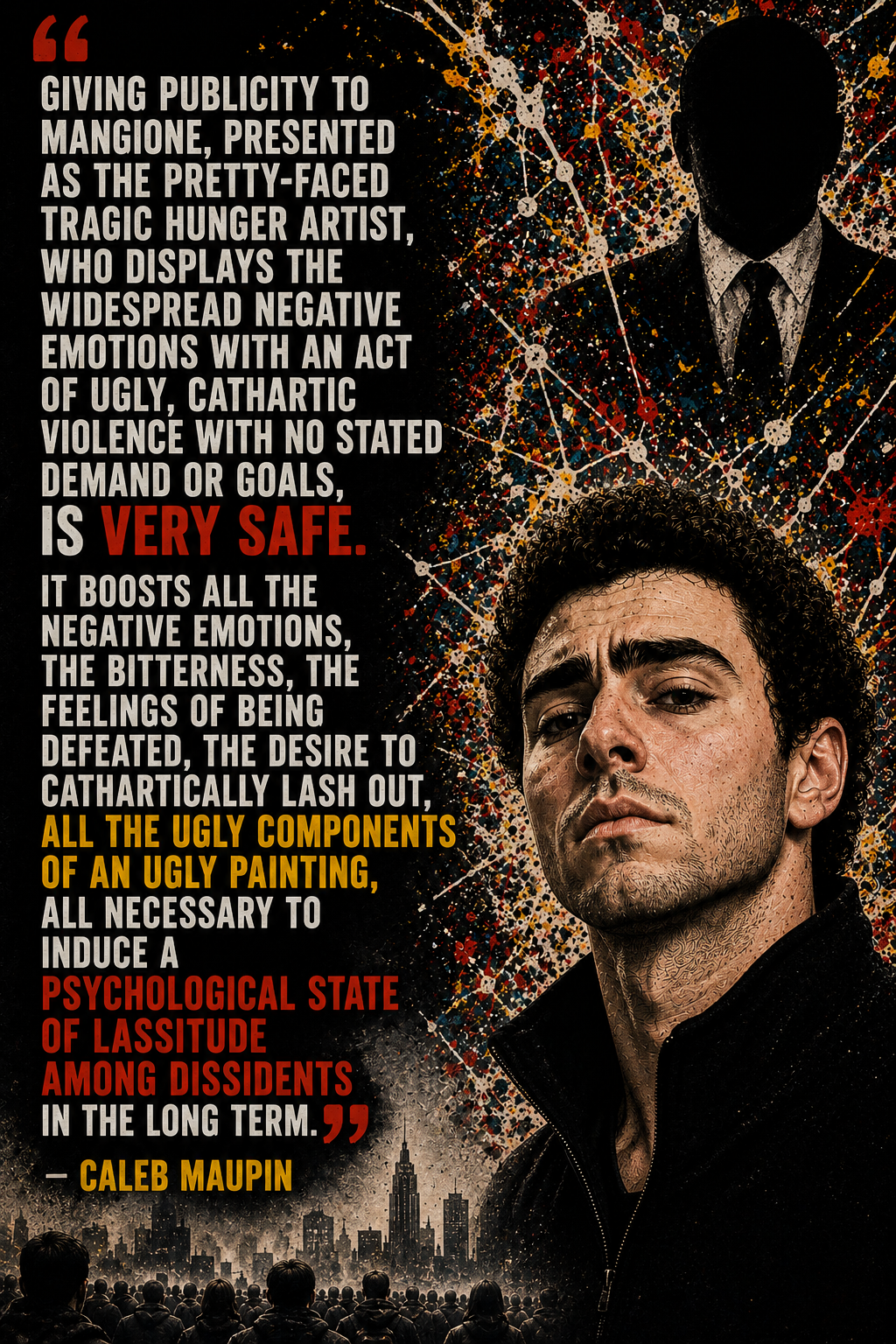
Yes, in the minds of those with no conception of a real mass movement, and no belief that we could create a society where healthcare is available to all, the idea of Luigi Mangione killing a billionaire CEO, inscribing political messages on the bullets, and composing a manifesto about vengeance and resentment, giving voice to the lingering anger and disappointments found throughout society, must indeed seem like an amazing art project. The media is all too happy to give non-stop coverage to this pessimistic Joker movie that appears to be playing out in real life. Giving publicity to Mangione, presented as the pretty-faced tragic hunger artist, who displays the widespread negative emotions with an act of ugly, cathartic violence with no stated demand or goals, is very safe. It boosts all the negative emotions, the bitterness, the feelings of being defeated, the desire to cathartically lash out with the lack of real goals, all the ugly components of an ugly painting, all necessary to induce a psychological state of lassitude among dissidents in the long term.
Conditions are getting worse. We all feel bad. We all feel like punching somebody or maybe even shooting somebody. Mangione did it, so we can celebrate him for making our bitter complaints heard without building any movement for change or even putting forward any demands, or even teaching us anything about the healthcare system or the unfolding crisis that we did not already know. We have a new anti-hero in the cable news cycle. We can give a bitter grin and say, “Somebody killed one of the bastards, good for them.” We can then go back to observing the negativity all around us, feeling completely powerless, and resuming our usual state of lassitude.
Do-Wacka-Do
American singer-songwriter Roger Miller released a humorous novelty song in 1964. He sang:
I hear tell you're doin' well,
Good things have come to you.
I wish I had your happiness
And you had a do-wacka-do,
Wacka do, wacka-do, wacka-do.
They tell me you're runnin' free
Your days are never blue
I wish I had your good-luck charm
And you had a do-wacka-do
Wacka do, wacka-do, wacka-do...
Socialism is largely considered in the American mind to be a movement based on jealousy. I was taught in elementary school that socialism and communism were “everyone getting paid the same.” Socialism is widely understood in the American mind to be “the redistribution of wealth” or moves to eradicate “income inequality.”
It is not surprising that, in a culture that values hard work, social mobility, and individual initiative, it is viewed in a very negative light. However, if one reads the work of Karl Marx or even other socialist thinkers who preceded him, one will not find calls for “equality of income.” On the contrary, one will instead find calls for rational planning and centralization of the means of production for the purpose of greatly expanding the productive forces.
The Communist Manifesto, for example, never calls for equality of wages or redistribution of income beyond vague references to an income tax system. The Communist revolution is described by Marx this way: “We have seen above, that the first step in the revolution by the working class is to raise the proletariat to the position of ruling class to win the battle of democracy. The proletariat will use its political supremacy to wrest, by degrees, all capital from the bourgeoisie, to centralize all instruments of production in the hands of the State, i.e., of the proletariat organized as the ruling class; and to increase the total of productive forces as rapidly as possible.”
The problem with capitalism, Marx explains, is that it is unable to sustainably increase living standards and instead creates frequent gluts, where poverty is created by abundance: “It is enough to mention the commercial crises that by their periodical return put the existence of the entire bourgeois society on its trial, each time more threateningly. In these crises, a great part not only of the existing products but also of the previously created productive forces are periodically destroyed. In these crises, there breaks out an epidemic that, in all earlier epochs, would have seemed an absurdity—the epidemic of over-production. Society suddenly finds itself put back into a state of momentary barbarism; it appears as if a famine, a universal war of devastation, had cut off the supply of every means of subsistence; industry and commerce seem to be destroyed; and why? Because there is too much civilization, too much means of subsistence, too much industry, too much commerce. The productive forces at the disposal of society no longer tend to further the development of the conditions of bourgeois property; on the contrary, they have become too powerful for these conditions, by which they are fettered, and so soon as they overcome these fetters, they bring disorder into the whole of bourgeois society, endanger the existence of bourgeois property. The conditions of bourgeois society are too narrow to comprise the wealth created by them. And how does the bourgeoisie get over these crises? On the one hand, by enforced destruction of a mass of productive forces; on the other, by the conquest of new markets, and by the more thorough exploitation of the old ones. That is to say, by paving the way for more extensive and more destructive crises, and by diminishing the means whereby crises are prevented.”
The idea, according to Marx, is that once the means of production are “centralized,” economic growth can continue without any restrictions as technology advances. The level of wealth and abundance in society can greatly increase. As Engels puts it in Socialism: Utopian and Scientific: “But when once their nature is understood, they can, in the hands of the producers working together, be transformed from master demons into willing servants. The difference is as that between the destructive force of electricity in the lightning in the storm, and electricity under command in the telegraph and the voltaic arc; the difference between a conflagration, and fire working in the service of man. With this recognition, at last, of the real nature of the productive forces of today, the social anarchy of production gives place to a social regulation of production upon a definite plan, according to the needs of the community and of each individual.”
In fact, Marx makes clear that his vision of a world without classes or inequality is only possible once the rational planning of the means of production has created vast abundance. In Critique of the Gotha Program, Marx specifically opposed the notion of equality of income, even in a socialist society, saying it was unworkable: “But one man is superior to another physically, or mentally, and supplies more labor in the same time, or can labor for a longer time; and labor, to serve as a measure, must be defined by its duration or intensity, otherwise it ceases to be a standard of measurement. This equal right is an unequal right for unequal labor.”

Tragic Prelude, a social-realist painting by John Steuart Curry honoring the anti-slavery revolutionary John Brown, hangs in the Kansas State Capitol Building.
He went on to make clear that equality could only be achieved when growth has been unleashed to create a huge amount of wealth: “Right can never be higher than the economic structure of society and its cultural development conditioned thereby. In a higher phase of communist society, after the enslaving subordination of the individual to the division of labor, and therewith also the antithesis between mental and physical labor, has vanished; after labor has become not only a means of life but life's prime want; after the productive forces have also increased with the all-around development of the individual, and all the springs of co-operative wealth flow more abundantly – only then can the narrow horizon of bourgeois right be crossed in its entirety and society inscribe on its banners: From each according to his ability, to each according to his needs!”
This notion of rational planning of the means of production, building up productive forces with a planned economy to eradicate scarcity and create a stateless, classless world on the basis of vast abundance, is completely contrary to what is widely believed by American “socialists” and “communists.”
On April 28th, 2020, leftist filmmaker Michael Moore touted his new climate change-themed documentary Planet of the Humans, by explaining that the problem with capitalism was it continued generating wealth endlessly: “We’re supposed to need more, more, more, more, more. This is killing this planet and we never stop to say, 'Do we have enough? When is enough? Enough!' Actually, I think the word ‘enough’ is the dirtiest word in capitalism, because there's not supposed to be any such thing as enough. Because we are told we need more, and companies are punished by Wall Street if they don't do more and grow more. Growth is really the death of us.”
Marx spent his entire life showing that capitalism did not create endless wealth, that rather it had a boom-bust cycle, and frequent gluts of overproduction (“value crisis”), and this problem was exacerbated by technology creating the “falling rate of profit.” All of this necessitated centralization and rational planning of the means of production so growth and technological advancement could move ahead, no longer restrained by the irrationality of the market.
However, this understanding is nowhere to be found among the American leftists who celebrate the murder of Brian Thompson. In their worldview, capitalism is “greed” and “wanting more,” and this is an inherent flaw in humanity. These are not the views of Marx or any of the 20th-century Communist governments. The entire purpose of their Five-Year Plans and mass industrialization campaigns was to create economic growth. The Communist Party of China obsesses over economic growth, and has raised 800 million people from poverty and created the second-largest economy on Earth.
As Dugin explained in The Last War of the World Island, starting in the 1970s, Communist groups began to function as caricatures of themselves, repeating stereotyped propaganda clichés assigned to them by their enemies and functioning in opposition to actual socialist planning in the USSR and China, while serving the Atlanticist international order: “Instead of strengthening its influence in the global leftist movement according to geopolitical interests, the USSR adopted those propaganda clichés that had been implanted into this movement by the pro-capitalist bourgeoisie powers interested in weakening the civilization of the land and strengthening the sea civilization. The representatives of the Fourth International, the Trotskyists, played a special role in this. Already radical opponents of Stalin and his policy of building socialism in one country from the 1920s and 1930s, Trotskyites made the USSR their main enemy, and in this fight with the USSR they joined with all the powers they could, including those they considered their class enemies. Hatred toward the USSR and Stalin became a main feature of Trotskyism and led many of its representatives to side with the liberal camp and join the ranks of the more consistent and radical Atlanticists. These groups contributed heavily to tearing the international left, and more importantly, the Communist movement, away from the USSR, beginning in the 1970s. Because of these processes, the USSR’s network of influence in countries outside of direct Soviet control was undermined, weakened, and partially removed from the coordinating control of Moscow.’”
The views of leftists who oppose capitalism because “there’s never enough” and “growth is really the death of us” are the views of Margaret Sanger, after she denounced Marxism and embraced Neo-Malthusianism and established the Birth Control League. Sanger condemned Marxism, writing: “No true solution is possible, to continue this analogy, until the worker is awakened to the realization that the roots of his malady lie deep in his own nature, his own organism, his own habits. To blame everything upon the capitalist and the environment produced by capitalism is to focus attention upon merely one of the elements of the problem. The Marxian too often forgets that before there was a capitalist there was exercised the unlimited reproductive activity of mankind, which produced the first overcrowding, the first want. This goaded humanity into its industrial frenzy, into warfare and theft and slavery. Capitalism has not created the lamentable state of affairs in which the world now finds itself. It has grown out of them, armed with the inevitable power to take advantage of our swarming, spawning millions.”
These ideas that Margaret Sanger and her wealthy financiers, who sponsored the Birth Control League, put forward in opposition to Marxism, have become synonymous with Marxism, Socialism, Communism, and Leftism in the public mind. Furthermore, these ideas do not oppose capitalism; they oppose growth. They oppose the expansion of the population, the increasing of consumption, the raising of living standards, etc.
If growth is bad, we should, of course, embrace lassitude. And why not be bitter at individual wealthy CEOs with lots of money? After all, in this "limited resources” worldview, wealth and the creation of wealth is inherently bad.
The anti-growth, anti-human, bitter, envious, vengeance-oriented, and overall pessimistic mindset is not going to lead a person to live a fruitful, happy, or prosperous life. It’s rather going to induce a huge amount of frustration and bitterness, which may flare up at times into rage (and acts of murder) but ultimately induces lassitude.

Monument to African Renaissance was constructed by North Korea in Senegal in 2010. A social-realist celebration of life, strength, optimism and family.
The Coming City
In the early 1900s, one of the most popular socialist writers and speakers was a friend of Eugene Debs named Wallace D. Wattles. Wattles ran for office on a socialist platform and gave two speeches that were widely circulated as pamphlets, arguing that Jesus Christ’s teachings were in line with socialist thought prior to his death in 1911.
Wattles was a Christian Socialist and friend of Eugene V. Debs, as well as a significant contributor to the New Thought movement, a philosophy that emphasized the power of thought, personal growth, and spiritual principles to achieve success. Long before Norman Vincent Peale wrote about The Power of Positive Thinking, Wallace Wattles introduced these ideas in The Science of Getting Rich, a seminal work that remains influential today.
In his book, which emphasized the importance of maintaining an optimistic and growth-oriented perspective, he said in very socialistic terms that the road to happiness and success lies in cultivating the very opposite mindset one finds in modern leftists. He wrote: “A seed, dropped into the ground, springs into activity, and in the act of living produces a hundred more seeds; life, by living, multiplies itself. It is forever Becoming More; it must do so, if it continues to be at all. Intelligence is under this same necessity for continuous increase. Every thought we think makes it necessary for us to think another thought; consciousness is continually expanding. Every fact we learn leads us to the learning of another fact; knowledge is continually increasing. Every talent we cultivate brings to the mind the desire to cultivate another talent; we are subject to the urge of life, seeking expression, which ever drives us on to know more, to do more, and to be more. In order to know more, do more, and be more we must have more; we must have things to use, for we learn, and do, and become, only by using things. We must get rich, so that we can live more. The desire for riches is simply the capacity for larger life seeking fulfillment; every desire is the effort of an unexpressed possibility to come into action. It is power seeking to manifest which causes desire. That which makes you want more money is the same as that which makes the plant grow; it is Life, seeking fuller expression.”
As someone who advocated for the central planning of the means of production, Wattles urged his readers even to think of the capitalist ruling class in a very different way than one has come to expect from “socialists” in our time, who preach jealousy and vengeance and find satisfaction in the killing of Brian Thompson. He wrote: “Men of the plutocratic type, who become very rich, do so sometimes purely by their extraordinary ability on the plane of competition; and sometimes they unconsciously relate themselves to Substance in its great purposes and movements for the general racial upbuilding through industrial evolution. Rockefeller, Carnegie, Morgan, et al., have been the unconscious agents of the Supreme in the necessary work of systematizing and organizing productive industry; and in the end, their work will contribute immensely toward increased life for all. Their day is nearly over; they have organized production, and will soon be succeeded by the agents of the multitude, who will organize the machinery of distribution. The multi-millionaires are like the monster reptiles of the prehistoric eras; they play a necessary part in the evolutionary process, but the same Power which produced them will dispose of them.”

The Christian Socialist writer Wallace D. Wattles put forward an argument against bitterness and resentment, urging socialists to envision “the coming city.”
Wattles argued that socialism was the inevitable result of human society’s march toward greater abundance, but it could only be achieved when the working class was awakened to an abundance mindset: “So the factory workers, either as individuals or as a class, are not deprived of opportunity. The workers are not being ‘kept down’ by their masters; they are not being ‘ground’ by the trusts and combinations of capital. As a class, they are where they are because they do not do things in a Certain Way. If the workers of America chose to do so, they could follow the example of their brothers in Belgium and other countries, and establish great department stores and co-operative industries; they could elect men of their own class to office, and pass laws favoring the development of such co-operative industries; and in a few years they could take peaceable possession of the industrial field. The working class may become the master class whenever they will begin to do things in a Certain Way; the law of wealth is the same for them as it is for all others. This they must learn; and they will remain where they are as long as they continue to do as they do.”
Wattles put forward a conception of understanding the struggles of workers for a better life, in an optimistic rather than bitter and resentful way, seeing it as the natural process of human growth and evolution, not a bitter struggle for power: “Nature is a great advancing presence, working beneficently for the happiness of all. All things in Nature are good; she has no evil. She is not complete, for creation is still unfinished, but she is going on to give to man even more bountifully than she has given to him in the past. Nature is a partial expression of God, and God is love. She is perfect but not complete. So of human society and government. What though there are trusts and combinations of capital and strikes and lockouts and so on. All these things are part of the forward movement; they are incidental to the evolutionary process of completing society. When it is complete, there will be no more of these inharmonies; but it cannot be completed without them. J. P. Morgan is as necessary to the coming social order as the strange animals of the age of reptiles were to the life of the succeeding period, and just as these animals were perfect after their kind, so Morgan is perfect after his kind. Behold, it is all very good. See society, government, and industry as being perfect now, and as advancing rapidly toward being complete; then you will understand that there is nothing to fear, no cause for anxiety, nothing to worry about. Never complain of any of these things. They are perfect; this is the very best possible world for the stage of development man has reached. This will sound like rank folly to many, perhaps to most people. ‘What!’ they will say, ‘Are not child labor and the exploitation of men and women in filthy and unsanitary factories evil things? Are not saloons evil? Do you mean to say that we shall accept all these and call them good?’ Child labor and similar things are no more evil than the way of living and the habits and practices of the cave dweller were evil. His ways were those of the savage stage of man’s growth, and for that stage they were perfect. Our industrial practices are those of the savage stage of industrial development, and they are also perfect.”

Mural depicting popular struggles inside the Hawaiin Labor Center for the International Longshore Warehouse Union (ILWU)
In line with this worldview, Wattles put forward a very different perspective on what kind of art and what kind of messages should be relayed to society by those who want to see a socialist world. He wrote: “The more you talk and think about your hard times, the more you will be inclined to seek some mental narcotic to dull the keen edge of your suffering; and the longer you will suffer. No surer way to keep the masses poor can be devised than to continually write and talk about their poverty. Talk about the good time coming. The good time IS coming, and the rapidity of its coming is in exact proportion to the number of people who think about it and talk about it. Instead of going about showing horrible pictures of the condition of those who live in the tenements, go about showing beautiful pictures of the conditions of those who will live in the coming city. If you can inspire one person to go to work for the coming city, you have done more good than you can by sending ten people out with slaves and plasterers to relieve existing distress. Instead of crusading against child labor and bad factory conditions, tell the working people what splendid conditions they will have when they wake up and begin to operate the industries for themselves. The masses are not in bondage to anything but ignorance and intellectual laziness; they can have what they will if they will begin to THINK.”
While Wattles was an idealist rather than a materialist—and with the acknowledgement that those seeking a Great Man to follow could, in theory, lean too far in and ignore the struggles of working people or the obstacles and contradictions that must be overcome—one must admit that in the statues found in the Moscow subways, the murals one sees in Venezuela, or the architecture of Pyongyang, the sentiments put forward by Wallace D. Wattles are quite prescient. In the artistic school the CIA looked to push against with abstract expressionism, in socialist realism, we do not see grunge, dirt, poverty, or calls for cathartic vengeance. Likewise, we do not see the bitterness and the lassitude that eventually comes from it. Instead, we see a glowing hope, a glorification of collective strength and energy. When we look at this art, we do not feel powerless, but rather we feel we can join this exciting project to build a brave new world. We feel emboldened, awakened, and energized. It should be no surprise that this “ideal of life as art, the cult of beauty, the fetishism of courage, the dissolution of alienation in the ecstatic feelings of community” is something many millions of our tax dollars have been spent trying to eradicate. It shouldn’t be shocking that hundreds and hundreds of pages have been written by CIA-backed leftist intellectuals and academics, inoculating us against this kind of message and the feelings it evokes as “fascist.”

“The Danger of An American Years of Lead” by Caleb Maupin. ORDER THE BOOK! or LISTEN TO THE FULL AUDIOBOOK