Why is it impossible to get this flower in America?
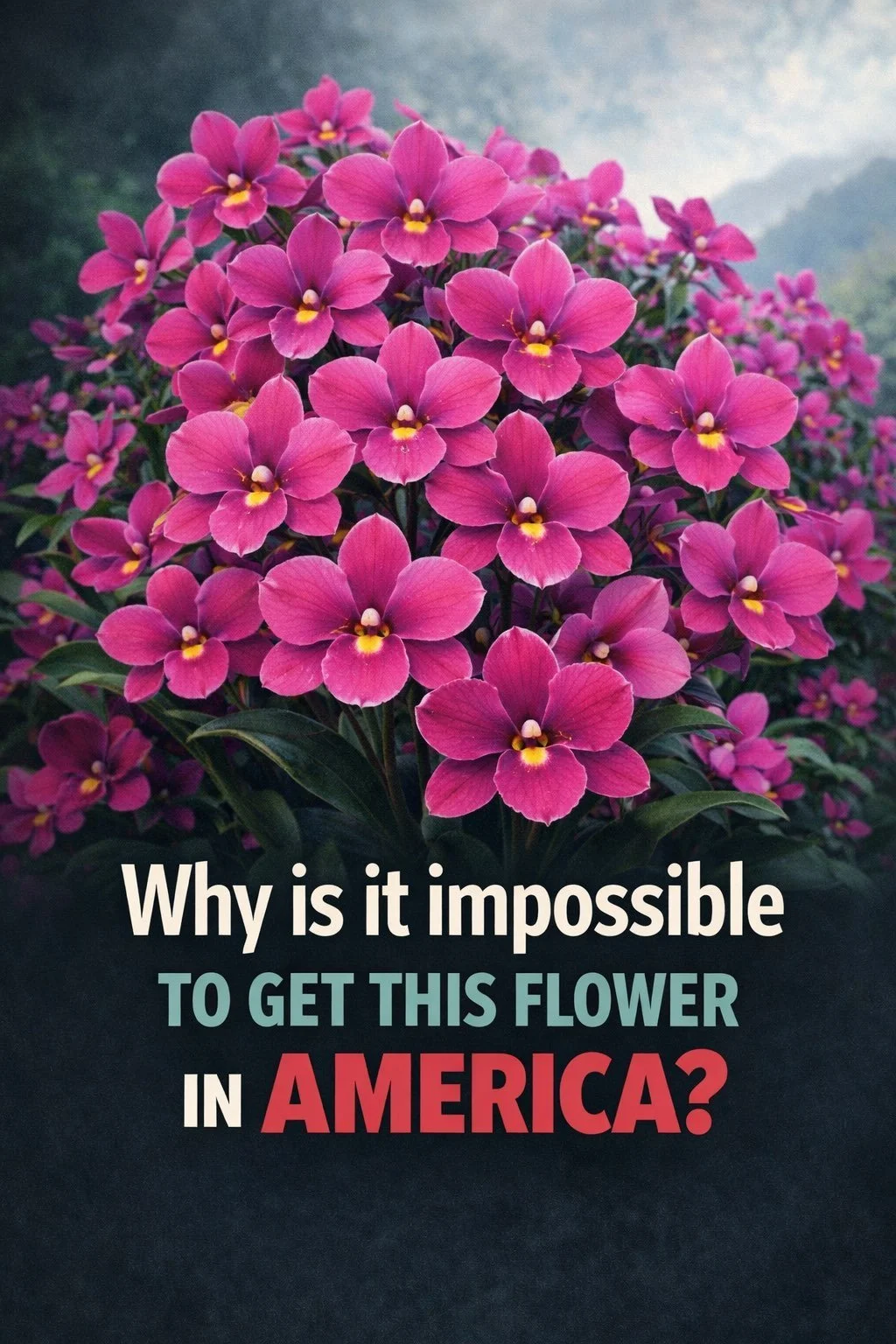
The flower on the cover was synthetically created in 1964 in Indonesia by Carl Ludwig Bundt. It is a hybrid orchid from the genus known as Dendrobium. However, it is known to the world as “KimIlSungia.”
The flower has this name because after it was created and began growing in Indonesia, two world leaders met there and discussed its beauty. From April 10th to 15th, 1965, Indonesian President Sukarno met with Kim Il Sung, the leader of North Korea. The two visited the Bogor Botanical Gardens just south of the Indonesian capital of Jakarta, saw the newly created specimen, and marveled at its beauty. Sukarno proposed that it be named “KimIlSungia” so it could serve as a symbol of eternal friendship between the people of Indonesia and Korea.
A Tragedy in Indonesia
Just months after the visit, Indonesia was changed forever by a horrendous military coup. With the support of the United States, the military violently toppled the popular and democratically elected President Sukarno. The CIA provided the names of Sukarno’s most outspoken supporters, and the military began slaughtering them. What began as mass executions of people for their political views soon escalated into events described as genocide against the ethnically Chinese community of Indonesia, which had supported Sukarno. Many estimate that roughly 500,000 people were killed in the murderous aftermath of the October 1965 coup in Indonesia.
One of the participants in this horrendous massacre was Lolo Soetoro, Barack Obama’s stepfather. Shortly after the massacres began, young Barack Obama’s mother, Ann Dunham, married a top figure in the Indonesian military and brought her son from Hawaii to live with her in Indonesia.
Sukarno, who named the KimIlSungia flower, was confined to house arrest and eventually died as the brutal military dictatorship that had overthrown him ruled the country. Today in Indonesia, Sukarno is viewed with great admiration as a popular reformer who built infrastructure, provided healthcare, and raised up the people of an impoverished country.
After Sukarno’s death, KimIlSungia was brought to North Korea. In 1975 the flower was cultivated in North Korea for the first time, and by 1977 it was introduced all over the country. It is now considered a symbol of North Korea, with a KimIlSungia festival taking place every year since 1998. The flower is used in almost every floral arrangement representing the government.
A Symbol of Liberation Struggles
In 1977, when KimIlSungia started growing all across North Korea, the country was supporting a group of activists on the other side of the planet — the Black Panthers. North Korea’s support for the Black Liberation movement in America was particularly bold. While the Black Panthers were being terrorized by the FBI in America, they were welcomed to Pyongyang like heroes. Huey Newton wrote, “The Democratic Peoples Republic of Korea is a shining example of what people can do when they seize their destiny from imperialism.”
North Korea did not only support the Black Liberation movement in America, but many anti-colonial struggles. The Palestinian cause was so close to the heart of the Korean leadership that Jindaellae Safarini is considered to be Kim Jong-Il’s daughter. Jindaellae’s father was the Palestinian ambassador to North Korea, and when he and her mother were unable to conceive, Kim Jong-Il arranged for fertility experts to visit them. When their daughter was ultimately born they named her Jindaellae after another beautiful Korean flower, and she eventually established a charity to provide healthcare to children.
When we think of North Korea, we don’t think of flowers or parents celebrating the birth of their children. Whenever the media mentions North Korea, it comes with images of goose-stepping soldiers, missiles, and tanks. But the Korean people don’t want war any more than we do. They live in a militarized state because they are fighting to maintain their existence, much like many other people around the world who want economic development and improvement of their conditions.
North Korea has been locked out of the world economy by the western leaders. They have been barricaded with economic sanctions and each year provocative war games are conducted with thousands of US troops in South Korea, rehearsing all out war. As a result, it is nearly impossible to get this beautiful flower in America.
A Man “Becoming the Sun”
Korea was occupied by Japan starting in 1910. As the sea-based empire of Japan brutally exploited the Koreans, using them as slave laborers and comfort women, they fought back. Among the Korean people, one figure who fought the Japanese occupiers was named Kim Il Sung, which translates to “Kim Becoming the Sun.” There were folk tales and legends about this figure, who was a beloved Robin Hood figure among the Korean people.
When Kim Song-Ju began fighting the Japanese occupiers, he named his division of resistance fighters the Kim Il Sung Battalion after the legend. As the Kim Il Sung Battalion became a celebrated and iconic force in the fight against Japan, Kim Song-Ju took on the name Kim Il Sung for himself as a way to incarnate the passion and heroism of the Korean people in fighting the occupiers.
Kim Il Sung represents the wave of anti-colonial liberation movements that defined the 20th century. In 1900, the world was run by big bankers and monopolies that were keeping the world poor. The British Empire burned the textile looms of India and forced the people to import their cloth from Britain. The people of the Congo were worked to death and mutilated on the rubber plantations of Belgium’s King Leopold. U.S. troops occupied the Philippines and slaughtered the people on many occasions.
The colonial powers — America, Britain, France, Germany, and Austria — battled each other in a horrendous event called the First World War. Europe was turned into a battlefield where trench warfare, aerial bombing, and poison gas killed 20 million people. The claim that the colonizers were “civilizing” people with their plunder was disproven before the world, as Europe became the scene of barbaric slaughter on a scale the world had never seen.
Out of the nightmare of World War One came the Russian Revolution. The Bolsheviks were Communists, but they had a new and unique interpretation of Marxism. They said the focus shouldn’t be on workers against employers, but on national liberation struggles against imperialism. The Bolsheviks announced support for anyone who would fight against the colonizers and Western monopolists who impoverished and enslaved nations. They supported the Emir of Afghanistan, a conservative monarchist, in his fight against the British. They convened the “Congress of the Peoples of the East” in Baku, Azerbaijan, to announce support for all who wanted to break free from colonial chains.
Nations Striving to Grow and Build
The Soviet Union began constructing and building up its economy in 1928 with Five-Year Plans. They proved to the world that it was possible to develop outside of the domination of the Western globalist system based on profits. With central planning, the Soviet Union built the world’s largest hydroelectric power plant, the biggest steel industry on the planet, and wiped out illiteracy. Russia had been an impoverished agrarian country, but under Stalin’s leadership it became an industrial powerhouse that eventually pioneered space travel.
After the Soviet Union played a decisive role in defeating Hitler during the Second World War, big chunks of the planet followed their example. Today, China is the second largest economy in the world. Eight hundred million people have been lifted from poverty. China was the “sick man of Asia” prior to 1949, but now it has the world’s largest telecommunications manufacturer, the largest steel manufacturing apparatus in the world, and it creates cutting-edge innovations in computer technology and artificial intelligence. It has also created the fastest trains on the planet, going over 260 miles per hour.
North Korea had major achievements after defeating the Japanese invaders and surviving the nightmare of the Korean War. Despite having every building in the country over one story tall destroyed, North Korea created a modern education system and wiped out illiteracy. As North Korea was rapidly industrializing in the 1950s and 60s, roads were paved, hospitals and schools were built, and millions of people achieved a standard of living never dreamed of prior to the revolution.
A BBC article from 2008, bemoaning the hardships North Korea faced after the fall of the USSR, admits this: “At one time, North Korea’s centrally planned economy seemed to work well — indeed, in the initial years after the creation of North Korea following World War II, with spectacular results. The mass mobilisation of the population, along with Soviet and Chinese technical assistance and financial aid, resulted in annual economic growth rates estimated to have reached 20%, even 30%, in the years following the devastating 1950-53 Korean war. As late as the 1970s, South Korea languished in the shadow of the ‘economic miracle’ north of the border.” (BBC News Article, “N Korea Struggles to Control Changing Economy,” Tuesday, 26 August 2008, Becky Branford)
After the fall of the Soviet Union, North Korea was subjected to a horrendous food crisis. The United States blocked them from importing oil and even paid those who fled over the Chinese border to go back into Korea and slaughter cattle. Amid this crisis the western powers were hoping to divide the Korean leaderships. The reason Kim Jong-Il and now Kim Jong-Un were chosen was to make clear that the Korean Workers Party would not be divided that the revolutionary line of its founder lives on. It is an important political statement, especially in traditional Korean culture where blood-lines and tribal lineage are considered very important.
North Korea has broken out western domination and fighting to build itself up. As Russia and North Korea get closer, economic conditions are really improving. The country has experienced a housing blitz, constructing new fancy homes by the hundreds of thousands. In addition, North Korea now is very involved in advanced technology. The mountains of North Korea are full of minerals that are vital in modern computer technology.
All the countries that have broken out of the globalist/imperialist system have been fighting for growth. To grow and see your living conditions improve, to have your children experience a more comfortable life than you, to expand life expectancy and the human population — this is the very nature of human existence.
Kim Il Sung is a leader who incarnated the struggle of the Korean people against imperialism, for development. Explaining the role of great individuals in history, G.V. Plekhanov wrote: “A great man is precisely a beginner because he sees further than others, and desires things more strongly than others… he points to the new social needs created by the preceding development of social relationships; he takes the initiative in satisfying these needs. He is a hero. But he is not a hero in the sense that he can stop, or change, the natural course of things, but in the sense that his activities are the conscious and free expression of this inevitable and unconscious course. Herein lies all his significance; herein lies his whole power.”
Human Beings Are Creative
Human beings are a creative species. Our ability to innovate defines us. While ants have been making their ant colonies the same way for thousands of years, and bees have been making their beehives the same way for thousands of years, in roughly 7,000 to 8,000 years human beings have exponentially expanded their population and gone from hunter-gatherer tribes to space travel and iPhones.
God is the creator of all things. Human beings are unique in that they have a god-like creative ability that no other species has. Humans are not simply another animal. They have a spark of divinity that allows them to reinvent their relationship with nature and ascend to a higher plane.
During the 20th century, many of the countries that broke out of imperialism were led by Communists. They professed an atheistic materialist ideology that often bemoans inequality. Because of this, many people do not understand the essence of what these revolutions were really about. They weren’t about “making everyone equal”; they were about fighting for economic growth.
The monopolistic capitalism of Western countries seizes nations throughout the world as captive markets and prevents them from building themselves up. This is the old British Empire Atlanticist economic model of militaristic states controlling trade routes and concentrating wealth in tiny financial metropolises.
However, as a result of the revolutions of the 20th century, a new economy exists in the world today. It is rooted in states that led anti-colonial revolutions and centrally plan the economy to ensure long-term growth. These are states that actively invest, not in false financialized wealth, but in families, communities, and human creativity and labor power.
Our Western system is collapsing because it is based on speculation and usury, not the solid physical growth of productive forces. Artificial intelligence has led to a prolonged economic crisis because the role of wage laborers in production is being gradually eliminated. Technological advancement should not lead to poverty. In an irrational system where profits are in command, what should be a world of glorious abundance and free time is becoming a low-wage police state and a nightmare of unfolding chaos.
In desperation, the leaders of the Western world are lashing out and trying to destroy the new BRICS world to keep their position at the center of the world economy. They are attacking Iran, North Korea, Cuba, Russia, and China. These are all countries that are part of a new economic system based on win-win cooperation between nations, not the monopolies of Western financiers.
Our Times Need Optimism
We must reject these wars and the emerging low-wage police state. We need an America that is restructured to join the new world and trade with countries on the basis of win-win shared prosperity. The so-called “left” does not understand this. They focus on resentment from historic injustices. They often preach that there are “limited resources” and that human beings themselves are the problem, not the outdated globalist/imperialist economic model. They tend to focus on atomizing humanity into hostile and competitive identity groups and wanting destruction as cathartic revenge.
The right-wing doesn’t get it either. They buy into the idea that we should have an economic system of “every man for himself” and ignore the need for the state to plan and rationally organize society so growth is unlimited. The right-wing often focuses on tribalism and identity politics of its own, inciting people to hate some group that can be scapegoated for the problems of the system.
Both the right-wing and the left-wing in America focus on pessimism. “There is no future,” “dark times ahead” — all of this is pumped out by all sides. This is the ideology of the international financial oligarchy. They want humanity to stop growing and expanding. But history is marching forward. Abundance is coming for all, and human creative power will not be contained.
Old political formulas cannot address the problems we are facing. “Left” and “Right” don’t even make sense anymore. This isn’t the Cold War, with Soviet Marxism-Leninism facing off against Western capitalism, liberal democracy. We need political innovation because the old political compass is completely broken. This is what the Center for Political Innovation is all about. Our main slogan is “We Need a Government of Action to Fight for Working Families.”
On A Mission To Spread Hope
We are lucky in America because we have someone who has dug into these big questions, traveled the world, studied not just politics but economics, psychology, and spirituality — and he understands it.
Caleb Maupin is from a small town in Ohio. But by the time he was 22 years old in 2010, he had moved to Cleveland, where he videotaped an act of police brutality and helped get a teenage girl acquitted in court. Caleb Maupin functioned as a media spokesperson for former U.S. Attorney General and international human rights lawyer Ramsey Clark during the Occupy Wall Street protests and the aftermath of the Arab spring in 2011-2013.
At the young age of 25, he was giving almost daily analysis to millions of people on international television. Before he was even 30 years old, he was flying to Brazil to give a two-hour presentation on the manipulation of international oil markets, greeted by President Michel Temer. He met with North Korean youth at a world gathering in Quito, Ecuador, in 2013.
In 2015, he risked his life as the only American on board a humanitarian mission — an Iranian Red Crescent ship destined for war-torn Yemen, loaded with medicine and doctors. Israel and Saudi Arabia both threatened to bomb the ship he was on, creating an international incident. On the ship, surrounded by deeply religious Shia Muslim medical volunteers, Caleb Maupin had a profound spiritual awakening and reconciled his lifelong commitment to anti-imperialism with his Christian faith.
Caleb is actually a descendant of one of the greatest spiritual leaders in American history, Charles G. Finney, the founder of the Second Great Awakening, an explosion of religious passion focused on opposing slavery in the 1800s. His ancestors worked on the Underground Railroad and were involved in the Irish freedom movement.
Caleb has had face-to-face meetings with multiple heads of state, such as Russian President Vladimir Putin and Iranian President Ebrahim Raisi. He is considered a cutting-edge analyst and thinker, invited to key global gatherings and consulted by some of the most important thinkers of the new BRICS world, such as Russian philosopher Alexander Dugin, Laureano Ortega, son of the President of Nicaragua, and many others. His books on geopolitics have sold thousands of copies and have been translated into multiple languages.
But Caleb refuses to just be another talking head, and despite all the threats he’s faced here in America, he refuses to expatriate. Caleb Maupin is American, and he loves America so much that he is committed to building what this country needs most: a movement.
The Center for Political Innovation functions as an educational project, a modern day peace movement that puts forward a vision of America as part of a multipolar world, living in peace, with wealth and abundance for all.
A new America will be built. Imagine if we had a government that invested in the next generation, paving roads, building decent schools, and enabling young people to start their own businesses to improve the country. Imagine if unemployment were eliminated and a national bank were established to strategically inject credit into our communities as part of a vision of long-term expansion. Imagine if we had social media apps with algorithms that made us smarter, healthier, stronger, and more creative. Imagine high-speed rail connecting the Midwest and South to the coastal areas of America. Imagine the United States teaming up with Russia and China to pioneer fusion energy and push humanity beyond the narrow limits of fossil fuels.
Innovationism:
A New Perspective and Mission
This is all part of Caleb Maupin’s vision and his new understanding called Innovationism. He understands economics, geopolitics, how the human mind works, and how we can connect with the higher power from which all goodness flows.
Innovationism isn’t about rage, blue team vs. red team, woke vs. MAGA, vengeance, fear, and all the ugliness of politics in our time. Caleb Maupin offers something completely new and beautiful, and all who come into contact with him can feel it.
As the U.S. launched its war against Iran, he decided that it wouldn’t be correct to do outreach talking about the horrors of death and war, but instead to show people a beautiful flower that is connected to the rising new America he seeks to empower us to build. That’s what inspired this booklet.
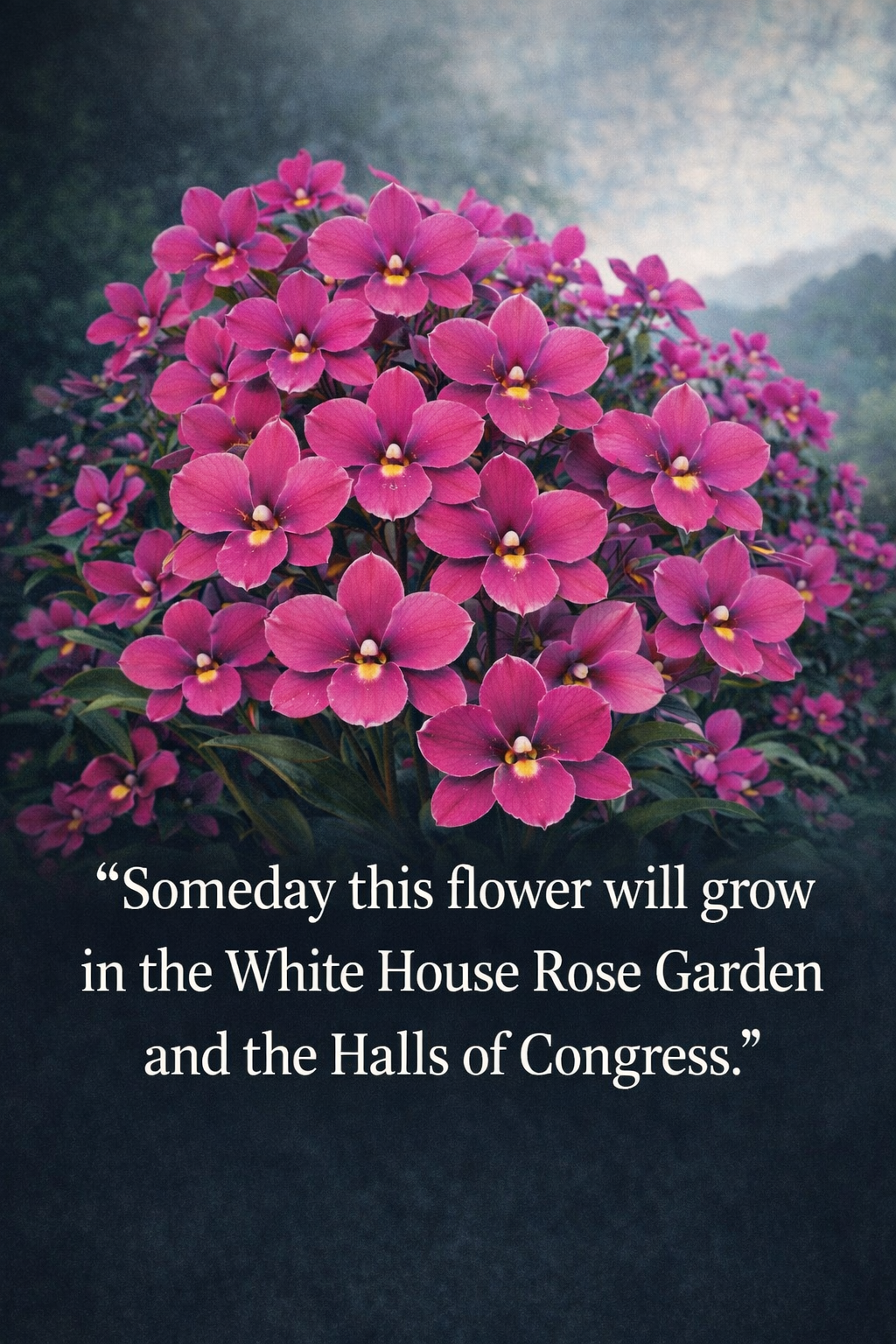
Right now in America, it is pretty much impossible to acquire KimIlSungia. But Caleb Maupin recently said, “Someday this flower will grow in the White House Rose Garden and in the halls of Congress.”
He sees in his mind’s eye the new America we will build together amid the crisis and confusion of our times. His vision is clear and precise, and he needs us to get involved and make it happen. Some people are chosen for a life of struggle, to walk on the great road and take up the challenge of history. You might be such a person. Learn more about the Center for Political Innovation.
There is indeed hope amid all the darkness of this world, but it is up to us to raise this light as high as we can and let it shine magnificently to make the whole world brighter than ever.